



Festival Cinespaña 2026 – Toulouse, France
What to expect in 2026
Cinespaña is a major festival dedicated to Spanish and Portuguese cinema, organised in Toulouse and extended throughout the Occitanie region. The festival is organised by AFICH, the Association du Festival International du Cinéma Hispanique, which was founded in 1996 to promote and distribute Spanish cinema in France and expanded its focus to Portuguese cinema in 2021.
The 2026 edition marks the festival’s return to a longer format in Toulouse, with a programme combining feature films, documentaries, short films, retrospectives, competitions, previews, special screenings, professional meetings, concerts, literary encounters and activities for younger audiences. The Cinémathèque de Toulouse also returns as a central festival partner and hosts the festival’s Village with a bar and tapas.
One of the principal highlights is a major retrospective dedicated to Spanish filmmaker Jonás Trueba. The programme covers much of his filmography and includes feature films, short films, a masterclass and a carte blanche exploring the filmmakers and cinematic influences connected with his work.
Enjoy Your Event Stress-Free with France Travelo
Planning a trip around a festival, concert, cultural celebration, or business event in France can be time-consuming—finding tickets, accommodation, transport, and local information takes effort. FranceTravelo makes it easier by bringing the essential information and travel support together in one place.
The festival is also presenting Carmen Maura with a Violette d’honneur. Her programme includes a career conversation and a presentation of Fernando Colomo’s Tigres de Papel, connecting the actress with one of the filmmakers who helped establish her early cinema career.
Cinespaña also maintains a strong regional dimension. Around 50 cinemas in Haute-Garonne and the wider Occitanie region participate in Cinespaña en Région with previews, national releases, classic films, school screenings and filmmaker tours.
Festival dates
Festival Cinespaña 2026 takes place from October 2 to 11, 2026, with the main festival programme in Toulouse. The Cinespaña en Région programme continues throughout October in participating cinemas across Occitanie.
The official festival opening is centred on the Cour de la Cinémathèque de Toulouse, with the Village, a concert and the screening of La bola negra at the American Cosmograph.
Visiting this event? Don’t miss out on these amazing activities and local experiences while you’re here.
Venues & festival locations
The festival uses a network of cinemas and cultural venues throughout central Toulouse.
Cinémathèque de Toulouse
The Cinémathèque at 69 rue du Taur is one of the principal festival locations. It hosts screenings, special programmes, filmmaker encounters and the Cinespaña Village. The Village provides a social meeting point with a bar, tapas and apéros-concerts.
ABC
The ABC cinema is one of Cinespaña’s main partner cinemas and screens selections from the festival programme, including contemporary films, young-audience material and special screenings.
American Cosmograph
Located in central Toulouse, the American Cosmograph hosts festival screenings and is the venue for the announced opening film La bola negra by Javier Calvo and Javier Ambrossi.
Le Cratère
Le Cratère is another major festival cinema and hosts contemporary releases, retrospectives, documentary competitions and films connected with Jonás Trueba’s programme.
Pathé Wilson
Pathé Wilson participates in the festival’s screenings and hosts major guest events, including the Carmen Maura career encounter and other festival programmes.
Instituto Cervantes and Médiathèque José Cabanis
Both cultural venues participate in Cinespaña programming. Some events at these locations are offered free of charge within available capacity.
Full programme
The 2026 programme covers Spanish and Portuguese cinema through several distinct strands.
Fiction competitions
The official fiction jury awards the Violette d’Or for Best Film from a selection of eight feature films that are unreleased in French cinemas. Additional awards recognise directing, acting, music, cinematography and screenplay.
New Filmmakers competition
The New Filmmakers Prize focuses on first and second feature films that have not yet been released in French cinemas. The festival also has a student jury that awards its own New Filmmakers Prize.
Documentary competition
The documentary competition presents six feature-length documentaries that are unreleased in French cinemas. The José-María Berzosa Prize for Best Documentary is awarded by the documentary jury.
Jonás Trueba retrospective
The retrospective includes Todas las canciones hablan de mí, Los exiliados románticos, La reconquista, Eva en agosto, Qui à part nous, Venez voir, Septembre sans attendre and Los Ilusos 13+13, together with the short films Miniaturas and Visitillas.
Carmen Maura tribute
The programme surrounding Carmen Maura explores her career and includes Tigres de Papel, the Fernando Colomo film in which she appeared at the beginning of her major screen career.
Plaisirs Subversifs
Created in partnership with the Cinémathèque de Toulouse, this cycle explores Spanish cinema during the democratic transition and examines the changes taking place in Spanish society and filmmaking.
Young audiences
Cinespaña also provides school screenings and educational material, with films selected for collège and lycée audiences. The programme includes works such as Winnipeg, el barco de la esperanza, A jamais les premières, Cervantes avant Don Quichotte, La langue des papillons, L’esprit de la ruche, Libertad, L’Olivier, Volver and Champions.
Featured films & premieres
The 2026 programme includes La bola negra, the second feature film by Javier Calvo and Javier Ambrossi, known collectively as Los Javis. The film received the Best Director award at the Cannes Film Festival according to Cinespaña’s announcement and is presented as the festival’s opening feature.
Jonás Trueba’s Los Ilusos 13+13 is another important contemporary title. The film is part of the filmmaker’s retrospective and is accompanied by other works that trace the development of his independent approach to filmmaking.
Rodrigo Sorogoyen’s L’Être aimé, also known as El ser querido, is included in the contemporary programme. The film examines a father-daughter relationship and themes surrounding masculinity and unresolved family history.
Carla Simón’s Romería is also programmed. The film continues Simón’s exploration of family history and memory and was selected in the official competition at Cannes.
The programme also includes contemporary documentary and experimental work. Todo es cárcel by Eloy Enciso and the short films Like moths to light and A planet painted by hand are examples of the wider selection.
Directors, actors & guests
Jonás Trueba is one of the principal guests of the 2026 edition. Cinespaña is awarding him a Violette d’honneur and presenting a near-complete retrospective of his work, alongside a masterclass and carte blanche.
Carmen Maura is also receiving a Violette d’honneur. She is scheduled to participate in a career discussion and a special presentation of Tigres de Papel with director Fernando Colomo.
Fernando Colomo has a particularly important connection to the Carmen Maura programme. His Tigres de Papel was his first feature film and provided Maura with one of her early major screen roles.
Other filmmakers represented in the programme include Rodrigo Sorogoyen, Carla Simón, Marta Díaz de Lope Díaz, Eloy Enciso, Víctor Diago, Maureen Fazendeiro and Gala Hernández López.
Screening schedule
Cinespaña publishes a detailed programme by day and a dedicated screening grid. Visitors can use the official schedule to identify individual films, screening locations and available sessions.
The programme covers several cinemas simultaneously, so visitors should check the venue carefully when planning consecutive screenings.
Some films receive multiple screenings at different venues. This is particularly useful for popular contemporary titles and retrospective films, allowing visitors additional opportunities to attend.
The schedule also includes special events alongside ordinary screenings, including filmmaker encounters, literary meetings, concerts and professional activities.
Ticket types & accreditation
Cinespaña offers several festival passes and individual tickets.
Unlimited Pass: approximately $62.32. This nominative pass is valid for all eligible screenings, subject to available seats.
10-film Pass: approximately $51.00. This pass is shareable and can be used across eligible festival screenings.
4-film Pass: approximately $28.33. This is a shareable option for visitors attending a smaller number of films.
Under-26 three-film Pass: approximately $14.74. This provides three-film access for eligible younger visitors.
ABC: approximately $10.20 full price and $7.93 reduced price.
Pathé Wilson: approximately $9.64 full price.
American Cosmograph: approximately $9.07 full price and $5.10 reduced price.
Le Cratère: approximately $7.93 full price, $5.67 reduced price and $4.53 super-reduced price.
Médiathèque José Cabanis and Instituto Cervantes: free admission within available capacity.
The festival states that passes are valid subject to available seats. Passes purchased online must be collected at the festival reception.
Industry & professional access
Cinespaña maintains a dedicated professional programme for people working in cinema and audiovisual production. Professional meetings bring together filmmakers, producers, distributors, programmers, sales agents and other industry participants.
The programme includes meetings between project holders from Occitanie, Navarre and Aragon and professional representatives from the cinema industry. It also includes the Istòria Lab residency, supporting feature-fiction and documentary projects.
Professional activities can include individual appointments, discussions and networking opportunities. Some activities are specifically reserved for cinema and audiovisual professionals, while others are open to students and cinephile audiences by registration.
The official accreditation system provides separate application routes for cinema professionals and journalists. Professional applicants use accredications@cinespagnol.com, while press accreditation is handled through the festival’s communications contact.
Red carpet & special events
The opening programme combines cinema with live cultural activity at the Cinémathèque. The festival Village provides a social meeting place with a bar and tapas, while the programme includes several apéros-concerts during the festival.
The opening film La bola negra provides a major cinema event at the American Cosmograph, while the presence of Jonás Trueba and Carmen Maura adds filmmaker and actor encounters to the programme.
Cinespaña also organises literary encounters. The programme includes meetings with writers and journalists, extending the festival beyond cinema into Spanish-language literature and cultural discussion.
The Village is particularly useful for visitors who want to combine screenings with informal social activities and food.
Festival rules
Festival passes are subject to availability and do not guarantee entry when a screening is full. The official ticket information specifically states that the passes are valid for all eligible sessions within the limits of available places.
The Unlimited Pass is nominative, while the 10-film and four-film passes are shareable. Online purchases require collection of the physical pass at the festival reception.
Individual ticket conditions can differ between cinemas, so visitors should check the specific cinema’s arrangements when purchasing a single screening.
Free events at the Médiathèque José Cabanis and Instituto Cervantes are also subject to available capacity.
Visitors should use the official festival schedule for the latest screening information because programmes can contain multiple venues, special events and guest appearances.
How to get there
Toulouse is the main host city for Cinespaña and the festival’s central venues are concentrated around the city centre. The Cinémathèque de Toulouse, ABC, American Cosmograph, Le Cratère, Pathé Wilson, Instituto Cervantes and Médiathèque José Cabanis can all be reached using Toulouse’s public transport network.
The festival specifically recommends using Tisséo for travel to its venues. Its practical information provides public-transport routes for visitors travelling between the different festival locations.
Visitors arriving by train can use Toulouse-Matabiau station and continue into the central city by public transport or on foot depending on their destination.
Toulouse-Blagnac Airport provides the city’s main air connection and is linked with Toulouse by public transport and road services.
Public transport & parking
Public transport is particularly useful during Cinespaña because several venues are located within central Toulouse. The festival directs visitors toward Tisséo routes when travelling between its screening locations.
Visitors attending several films in one day should check the travel time between venues before booking consecutive screenings.
For drivers, central Toulouse has public parking facilities, but availability can be affected by city-centre traffic and demand. Visitors staying centrally may find public transport more practical than moving between cinemas by car.
The festival’s concentration around central cultural venues also makes walking a practical option for some journeys.
Accommodation areas
The city centre is the most practical accommodation area for visitors attending multiple Cinespaña screenings because several participating cinemas and cultural venues are located centrally.
The area around the Capitole, Carmes, Saint-Cyprien and Compans-Caffarelli districts provides access to restaurants, public transport and central cultural attractions.
Visitors who want to remain close to the Cinémathèque can look for accommodation around the historic centre and rue du Taur. This reduces travel time to the festival reception and Village.
Those planning to attend events at Le Cratère or venues further south can also consider accommodation with convenient access to Toulouse’s public transport network.
Food & dining
Food forms part of the social side of Cinespaña. The festival Village at the Cinémathèque includes a bar and tapas, creating a dedicated place where visitors can meet before or after screenings.
The festival also combines cinema with social events such as apéros-concerts, making the Village more than simply a ticket collection point.
Central Toulouse provides a large selection of cafés, restaurants, bakeries and bars around the principal cinemas. Visitors can therefore choose between eating at the festival Village or exploring the surrounding city.
The availability of several venues within central Toulouse makes it possible to plan meals around screening blocks without requiring long journeys.
Accessibility
Cinespaña has published accessibility information for its festival venues. Its accessibility guide identifies arrangements for people with reduced mobility and covers participating locations including the ABC, Instituto Cervantes, Toulouse library network, Le Cratère, American Cosmograph and ENSAV.
Because accessibility facilities vary between venues, visitors with specific requirements should check the individual cinema information before booking.
The central location of many festival venues provides access to Toulouse’s public transport network, while individual cinemas can provide their own information concerning accessible entrances and seating.
For detailed accessibility requirements, contacting Cinespaña or the relevant cinema directly before attending is the safest way to confirm available facilities.
Best screenings to attend
Jonás Trueba retrospective
The retrospective offers one of the most extensive ways to discover Trueba’s work, ranging from Todas las canciones hablan de mí and Los ilusos through La reconquista, Eva en agosto, Qui à part nous, Venez voir, Septembre sans attendre and Los Ilusos 13+13.
Los Ilusos 13+13
This contemporary work is particularly relevant for visitors following the Jonás Trueba programme because it represents his continuing interest in independent, collaborative filmmaking. Cinespaña also identifies screenings accompanied by an invited guest.
L’Être aimé
Rodrigo Sorogoyen’s L’Être aimé offers contemporary Spanish cinema centred on family relationships and masculinity. The festival’s presentation connects the film with Sorogoyen’s broader body of work.
Romería
Carla Simón’s Romería provides another contemporary feature, connecting personal and family memory with the filmmaker’s continuing interest in autobiographical storytelling.
Tigres de Papel
The Fernando Colomo classic is an important choice for visitors interested in Carmen Maura’s early career and Spanish cinema during the democratic transition. Cinespaña presents it as part of the Carmen Maura programme.
Plaisirs Subversifs
This programme offers a historical perspective on Spanish cinema during the transition to democracy and is especially relevant for viewers interested in the relationship between cinema and social change.
Previous year’s highlights
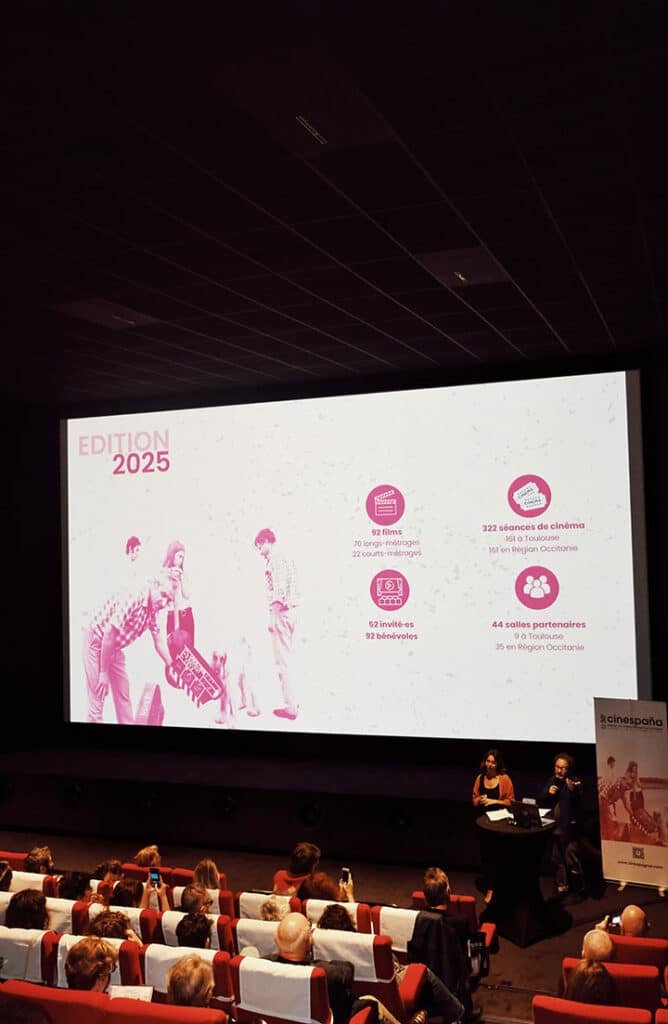
The previous edition was the festival’s 30th edition and recorded 13,534 spectators. Of those, 9,058 attended screenings in Toulouse, 2,246 attended activities in the Occitanie region and 2,230 additional viewers watched films through the Spanish VOD platform Filmin.
The festival presented 110 films across Toulouse and the region, including 88 feature films and 22 short films. There were 332 cinema screenings, divided between 162 screenings in Toulouse and 170 in regional venues.
The previous programme included opening films such as Maspalomas by Aitor Arregi and José Mari Goenaga and Daniela Forever by Nacho Vigalondo. The closing programme featured El 47 by Marcel Barrena.
The festival also continued its regional programme, with participating cinemas presenting Spanish and Portuguese films, previews, classics and filmmaker tours.
The 2025 figures demonstrate the scale of Cinespaña’s network, with substantial participation from both Toulouse audiences and cinema venues throughout Occitanie.
Official tickets & accreditation
Tickets and festival passes are available through the official Cinespaña ticketing system. Visitors can choose between unlimited access, multi-film passes and individual cinema tickets depending on how extensively they plan to attend the programme.
The Unlimited Pass is approximately $62.32, while the 10-film Pass is approximately $51.00 and the four-film Pass is approximately $28.33. The under-26 three-film Pass is approximately $14.74.
Individual cinema prices range from approximately $5.10 to $10.20 depending on the venue and applicable rate. The Médiathèque José Cabanis and Instituto Cervantes offer free admission for eligible events within available capacity.
Professional and journalist accreditation is handled separately. Cinema professionals can apply through the professional accreditation contact, while journalists use the dedicated press route listed on the official festival website.
Cinespaña also organises professional meetings for filmmakers, producers, distributors, programmers and audiovisual students. Some professional activities are available by registration, while others are restricted to professionals by invitation or request.
The official Cinespaña website remains the primary source for tickets, accreditation, the complete programme, screening grid, guest announcements and regional programming.
Tickets Sell Out
in Minutes
Maps
Contact
Video
FAQ's
What is Festival Cinespaña?
Cinespaña is a festival dedicated to Spanish and Portuguese cinema and is organised by the AFICH association in Toulouse. Its programme combines contemporary films, competitions, documentaries, retrospectives, previews, short films and cultural events. The festival also extends into cinemas throughout the Occitanie region through Cinespaña en Région.
Which cinemas host Cinespaña in Toulouse?
The main Toulouse venues include the Cinémathèque de Toulouse, ABC, American Cosmograph, Le Cratère, Pathé Wilson, Instituto Cervantes and Médiathèque José Cabanis. These venues host different parts of the film programme, competitions, retrospectives, special events and cultural activities. The festival also recommends using Tisséo public transport to travel between its locations.
Who are the main guests of the 2026 edition?
Jonás Trueba receives a Violette d'honneur and is the subject of a major retrospective, masterclass and carte blanche. Carmen Maura also receives a Violette d'honneur and participates in a career encounter and a special presentation connected with Fernando Colomo. Other filmmakers and guests are associated with individual screenings and regional tours.
Does Cinespaña have competitions?
Yes, the festival has fiction, New Filmmakers and documentary competitions. The official fiction jury awards the Violette d'Or for Best Film as well as prizes for directing, acting, music, cinematography and screenplay, while the documentary jury awards the José-María Berzosa Prize. A student jury also selects a New Filmmakers prize.
Does Cinespaña take place outside Toulouse?
Yes, Cinespaña en Région works with around 50 cinemas across Haute-Garonne and Occitanie. Participating cinemas can present Spanish and Portuguese films, previews, national releases, classics, school screenings and filmmaker tours. This regional programme significantly expands the festival's reach beyond the main Toulouse venues.